You do not need to be a pathologist to be a good caretaker; you just need to notice when something is off and know roughly what you are looking at. Here are ten diseases you might encounter in a north Georgia yard, sorted into the groups they belong to. If you want a shorter version, our post on five common tree diseases covers the essentials.
Leaf and needle diseases
Anthracnose
A common fungal disease, especially on dogwoods, sycamores, and maples in our wet springs. It shows up as irregular brown or tan blotches along the leaf veins, curled or distorted leaves, and early leaf drop. Rarely fatal on its own, but repeated years wear a tree down.
Apple scab
Mostly seen on crabapples and apples, apple scab appears as olive-green to black velvety spots on leaves and fruit, leading to yellowing and heavy leaf drop by mid-summer. It is unsightly and stressful to the tree but usually manageable with cleanup and good airflow.
Powdery mildew
The familiar white, powdery coating on leaves and shoots, thriving in our shade and humidity. It is more cosmetic than deadly on most trees but stresses new growth. Sun and air circulation are the best defenses.
Cedar-apple rust
An unusual disease that needs both a cedar or juniper and an apple or crabapple nearby to complete its life cycle. It causes bright orange spots on apple leaves and strange gelatinous orange growths on junipers. Spacing the two hosts apart helps.
Dothistroma needle blight
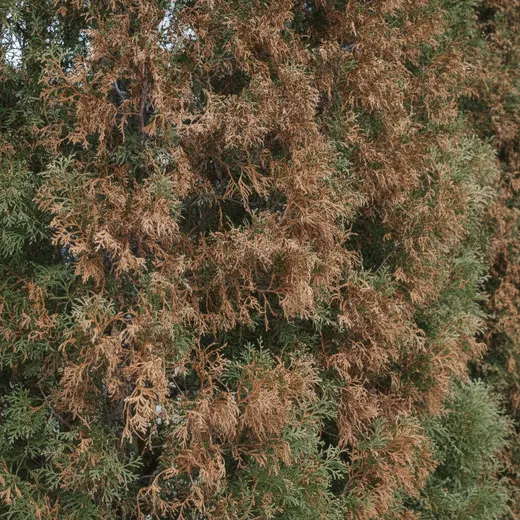
A needle disease of pines that browns and kills needles from the tip inward, often with a dark band where healthy tissue meets dead. It thins the canopy over several seasons and hits stressed and crowded pines hardest.
Cankers and blights
Canker diseases
Cankers are localized dead areas on branches or trunks, often sunken, discolored, or oozing, where a fungus has invaded, usually through a wound or a stressed spot. They cut off the flow past that point, so everything beyond browns and dies. Stressed trees are far more susceptible.
Fire blight
A fast-moving bacterial disease of pears, crabapples, and their relatives. Branch tips wilt, blacken, and curl into a shepherd's crook as if scorched. It needs prompt pruning well below the infection, with tools cleaned between cuts.
Diplodia tip blight
A fungal disease of pines that kills the new shoots and needle tips, leaving stunted, browned candles at the branch ends, often on older or stressed trees. It works from the lower canopy upward over time.
Wilts and root rots
Oak wilt
A serious fungal disease that blocks an oak's water-conducting vessels, causing rapid wilting, browning, and leaf drop, and it can kill an oak in a season. It spreads through fresh wounds and through connected roots, which is why oak pruning timing matters so much.
Phytophthora root rot
A soil-borne disease that rots the roots and lower trunk, especially in wet, poorly drained ground, our clay in a wet year. Above ground it looks like general decline: thinning canopy, yellowing, dieback, because the roots below can no longer supply the tree. Good drainage is the best prevention.
How Engram's Tree Service can help
Recognizing a disease is the first step; managing it correctly is the rest, and the right move differs for every one on this list. Our certified arborist can diagnose what you are dealing with and advise whether a tree needs pruning, care, or removal to protect the ones around it. If something on your trees does not look right, reach out for a free estimate.